Thursday, 22 January 2015

Reverance List


‘Pina Bausch facts’ [Online] Available from: http://www.encyclopedia.com/topic/Pina_Bausch.aspx#1 [accessed 22nd January 2015]

Helyeahz (14 December 2011) Pina Bausch - Café Müller (1978) available at: https://www.youtube.com/watch?v=36s1UxPM9LA (accessed 22 January 22, 2015)

DecorporationNotes (20 September 2011) Tadeusz Kantor - Wielopole, Wielopole (excerpt) available at: https://www.youtube.com/watch?v=qkKaSSqOAFE&x-yt-ts=1421782837&x-yt-cl=84359240 (accessed 22 January 22, 2015)

Gaswinck (20 February 2010) Jerzy Grotowski interview Wywiad z Jerzym Grotowskim available at: https://www.youtube.com/watch?v=y1nA4HCa6zI&x-yt-ts=1421828030&x-yt-cl=84411374 (accessed 22 January 22, 2015)


Our Performance


Our final performance took all that we wanted to include, we were inspired by the use of memory in all of the practitioners work. From the use of stripped back motions of Grotowski and the openness of Bausch and the harsh reality of events of Kantor. We wanted to make a piece that showed an aspect of each of these theatre directors.

First we did a Bausch inspired walk to an up tempo "happy" song that would invite the audience into our world but as the song would determinate so would our motions going from happy and individually interpreted to becoming twisted and disjointed. as we fell to the floor we took on inspiration of more of Bausch's work and had the audience be a barricade for our blinded individual to work though, very similar to Bausch's Café Müller, we wanted to express the genuine fear that the girl who was blindfolded had, as the panic driven runs and breaths where her genuine reaction to not being able to see, this was all inspired by her story of how she partially blinded someone and this was a way for her to experience what she has now put that individual through.

Than we had a more Grotowski feel to the next part of the performance as we had one performer throw and roll across the floor, remembering of his story of vandalism and hiding, all the performance was here was just him running and hiding.

Then was me section of the performance which had as much realism as I could put into it, it was a story of how I shot myself by mistake and how I had to walk home with an injured leg to show this I had to drag another performer across the stage, this part of the performance used both Bausch and Grotowski methods to symbolise the path of the bullet to me, via Bausch inspired ballet and my reaction to being shot based on actual reactions for having my leg be weighed down.

After that we had our final section which also used the actual reactions of the performer involved, throughout the performance we had this individual moving the audience and us into position, this person was our Kantor, she would change things that needed to be done for the sake of the performance, her story was how she was lost as a child and when found she was dragged to home and then welcomed back with a warm embrace.

We found the idea of going through something traumatic and then finding solace in the embrace of another, this is how each part of the performance would end with us embracing and telling part of our story to the audience. our endgame was to leave the piece open for interpretation by the audience but in my own interpretation of the whole piece I believe that the finally embrace of all the actors and audience indicates that no matter what bad things that have happened in the past have all lead up to us all being there together, it is a piece that is very peaceful in that sense.

Jerzy Grotowski


The late theatre pioneer Jerzy Grotowski turned to the stage because, as a restricted arena, it received a leeway not given to more mass-based activities like film and journalism in Soviet-era Poland.
Jerzy Grotowski Photo by  Andrzej Paluchiewicz


Jerzy Grotowski could easily be depicted as the pioneer of physical theatre and even the biggest impact on our piece as far as I'm concerned, his work is what we strived for the most. He focused on the real emotions of his performers, he used techniques like emotional recall and training an actor's body to the point that their emotions would be peeked.


He created 'Poor Theatre' a type of performance space where all that would be provided is the performer and the audience. Grotowski focused on the interaction between the two he wanted everything that wasn't necessary to telling the story to be removed.


Even the concepts of "character" seemed to be suspicious to Grotowski, he believed that it was a waste of an actor's time to pretend to be something that they are not nor may never be. his believe is that it is the audience that create a character based on what is provided to them by the actor's body and voice, so instead of having a performer having to learn a body action he would let them draw upon previous experience. This plays so nicely into our work that we were using our own experiences of the actions to make it even more realistic for us and the audience.


Jerzy Grotowski used very little but the impact of what he did was large, he rearranged what physical theatre could achieve, he knew what needed to be shown to make an impact on an audience and he knew what needed to be taken away to make an impact on the actor.


Grotowski Interview


Grotowski knew that theatre was not an image, it was not an ever repeating event. It was an experience made real to the audience by the presence of an actor that is why so little is used in a performance and this is also why he doesn't want anything to be pretended for a performance as he always said:


“If you want to create a masterpiece, you must always avoid beautiful lies.”
― Jerzy Grotowski


Tadeusz Kantor


Kantor was a man of suffering. he had lived through many horrors in his life, witnessing the holocaust and the second world war through his own eyes, Kantor worked as a painter, set designer and theatre director.


 Kantor was inspired by surrealistic work, he loved to work with Bio-objects, a concept he came up with through his own work and love of the idea that paintings can be link with reality as reality can be link with the paintings. Bio-objects range from two different ends of a spectrum, the one side having the performer be part of the painting, creating one image, whereas the other side is the performer is not allowed to part with a object and must make that object be obvious for the audience.

his love of the painting lead him to become a more integral part of his performances, he would sit on stage with his performers and make sure they were being the painting he wanted them to be. he would come and rearrange a performer if he didn't believe that they were making as big of an impact as he wanted. this can be noted most in his piece Wielopole, Wielopole.


Wielopole, Wielopole


the act of interacting with the performers is one that intrigued me, I loved the idea of having a set image in your mind and having that expressed in a way that the audience would see as a experience this would bring the viewers into your world more.


Kantor also loved to use memories to express a story but the memories he would usually pick are not the happiest Varity, in keeping with his theatre of death motive the vast majority of his work was focusing on the bad experiences in his life, this works especially well with our piece as each of our own stories relate to a moment of pain or guilt in our own lives.

Pina Bausch


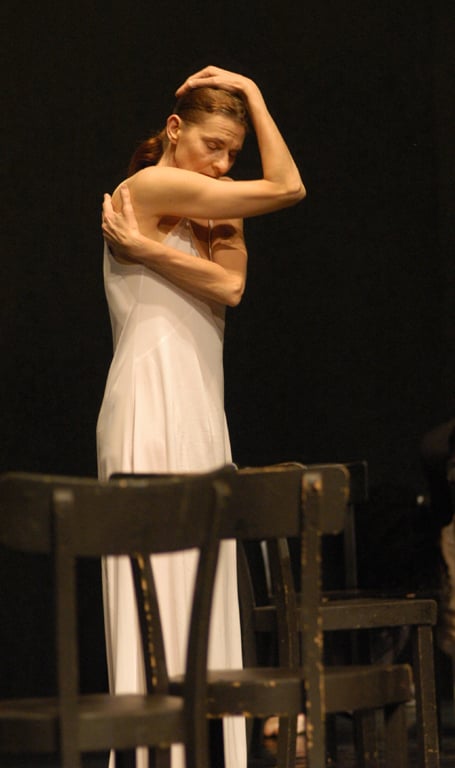
Pina Bausch – Café Müller, Tanztheater Wuppertal (Photo Ulli Weiss)


Pina Bausch was a renowned choreographer who experiment with emotional based shows rather than skill based shows, at a young age she leaned ballet but when she worked with a dance teacher named Kurt Jooss at the Folkwang School in Essen, Jooss focused more on the free spirited nature of dance whilst also using the fundamental rules of classical Ballet.

Pina grew up during a time of war and fear and she loved to bleed her experience and emotions during that difficult time in her life into her pieces of work, this again was inspired by her old teacher Jooss, who was renowned for being a liberal, free thinking individual who did many pieces on Anti-war most notably his Green table piece.

At the age of 19 Pina worked in New York as part of a student exchange programme, she worked in the Metropolitan Opera Ballet and the New American Ballet, but she said it was the atmosphere of New York that gave her an idea of what she wanted to do in her life. Bausch, 2004 said that "New York gave me a feeling of freedom, there is where I found myself"

She later returned to Germany and worked on many piece that were extremely useful to my performance, my group to a large amount of inspiration from her piece Café Müller, the raw emotion and physical exhaustion brought on in the piece is such an experience and it is a great display of Pina's love of including childhood experiences into a piece.


Café Müller is a performance based on Pinas childhood it is filled with the openness the Bausch's work was renowned for it leaves it's self open for interpretations and that is an aspect we wanted to engrain deeply into our performance.